

Every LearnWisej.NET course is completely free — no subscriptions, no credits, no checkout — and available in English, German, Italian, French and Spanish. And every course pairs videos, labs and runnable samples with an AI Coding Exercise, because that is how developers actually build software now.
Learning a development framework shouldn't mean spending hours watching someone type code that you could simply copy from a repository.
That's why we built LearnWisej.NET differently.
Every LearnWisej.NET course is completely free. No subscriptions, no credits, no checkout. Create an account and start learning.
But free is only part of the story.
This Is Not an Old-School Coding Course
Modern developers increasingly work with AI coding assistants such as ChatGPT and Claude. Teaching development as if every class and event handler still needs to be typed manually from a blank file doesn't make much sense.
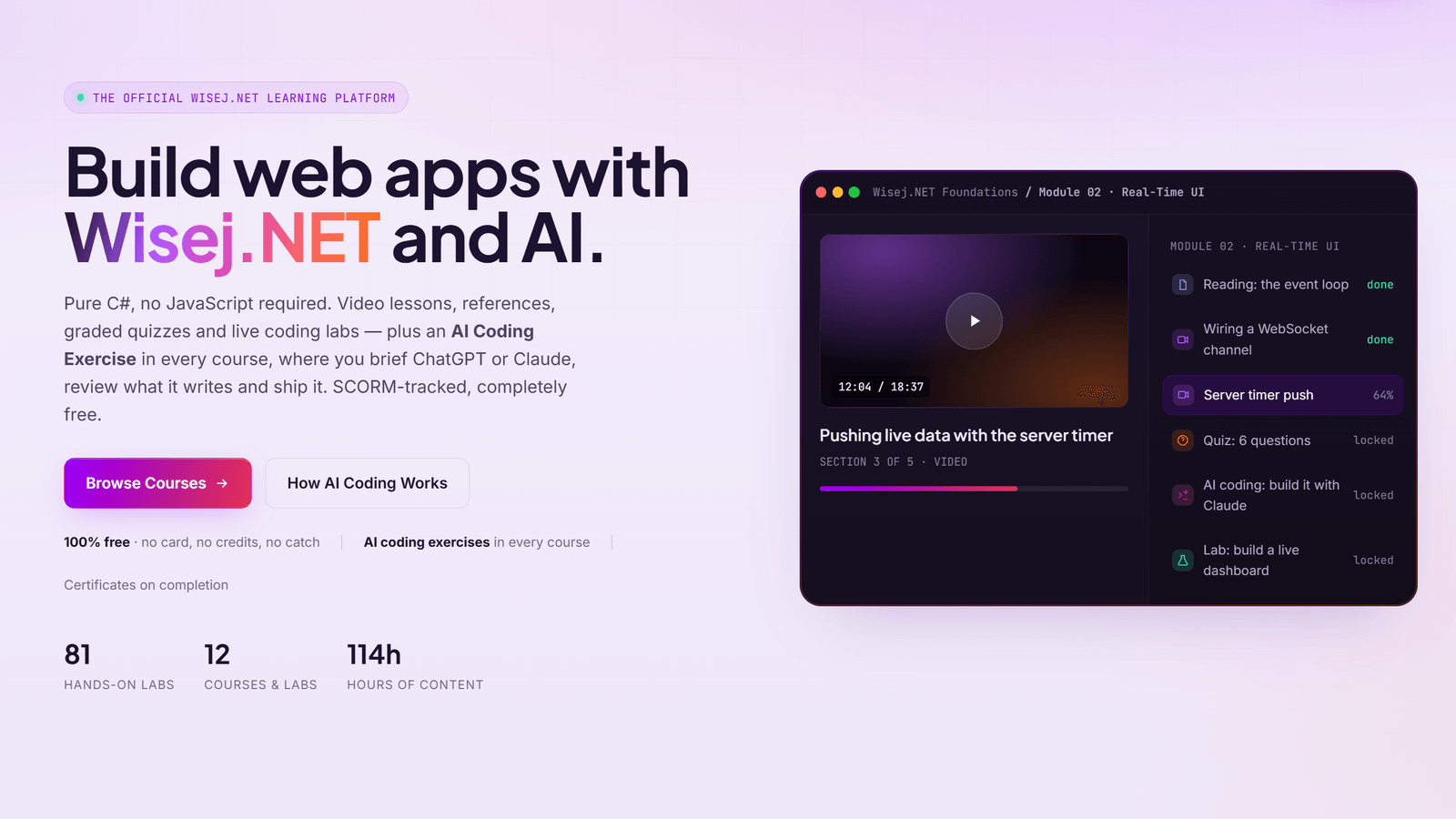
LearnWisej.NET combines educational videos, reference material, quizzes, hands-on labs and dozens of complete runnable samples with an AI Coding Exercise in every course.
Instead of simply reproducing a sample line by line, you give an AI assistant a real Wisej.NET specification and ask it to build the application.
Then the important part starts.
You run what it generated, review the code, identify what the AI got right or wrong, correct it, compare it with our reference implementation, and extend it.
You learn Wisej.NET and how to work effectively with AI as a developer.
See the Concepts, Then Build Them
The videos aren't just code-along recordings.
For example, in the Real-Time Apps with Server Push course, the WebSocket Push vs. Polling lesson explains and demonstrates three different ways a web UI can receive updates: updates returned with a normal request, server-initiated WebSocket push, and polling as a fallback.
The accompanying TicketOps Live sample lets you actually see those mechanisms working: start a server heartbeat, watch updates arrive without a click, compare push with polling, generate high-frequency updates, batch them, inject a failure and recover from it.
It's a much better way to understand why an architecture works than simply copying an Application.Update() call.
Watch: WebSocket Push vs. Polling
Pick a Path
New to Wisej.NET? Wisej.NET Foundations goes from the application model and Visual Studio designer through controls, events, data binding, real-time UI, theming, integration and deployment.
Already an experienced .NET developer? There are more focused courses.
From WinForms to the Web shows how to bring desktop development skills and existing applications to the web without abandoning the .NET programming model.
Theming & Responsive Layouts covers themes, CSS, responsive properties, docking, anchoring, FlowLayoutPanel, TableLayoutPanel and FlexLayoutPanel for adaptive desktop and mobile interfaces.
Application Integration dives into JavaScript widgets, custom controls, server/client communication and integrating third-party browser components.
Real-Time Apps with Server Push explores WebSockets, polling, background tasks, update cadence and multi-session real-time applications.
And the advanced courses go all the way through production architecture, security, cloud deployment and enterprise application design.
Learn in Your Language
Wisej.NET developers work all over the world, so LearnWisej.NET does too. Every course is available in English, German, Italian, French and Spanish.
Pick the language you think in and follow the whole course in it — no need to learn a framework through a second language at the same time.
Learn With AI, Not Around It
AI is changing software development, but it isn't eliminating the need to understand what you're building.
Developers need to become better at defining requirements, understanding architecture, reviewing generated code and recognizing when the AI is wrong.
That's the philosophy behind LearnWisej.NET:
Learn the concept. See it working. Give AI the specification. Review what it builds. Make it better.
And the entire LearnWisej.NET catalog is free — in all five languages.